7TH EDITION
INSIGHTS
 ·
·A CRISIS DECADES IN THE MAKING

Key Insights
The Chocolate Crisis: Time to Act
The cocoa industry is in turmoil. Price volatility means that companies are feeling some of the pressures farmers have faced for years. The burden of risk cannot fall on farmers alone.

The Scorecard's ten-year arc has been from ‘we don't know’ to ‘we know.’ The next decade is from ‘we know’ to ‘we have closed the gap.’ Fuzz Kitto - Chocolate Scorecard

“In my quiet moments, as I try to find solutions, here's what I've learned: Crisis creates Clarity. The clarity is this: We must build our own capacity to act.”
President John Mahama of Ghana
Transparency
Drives
Credibility and Accountability
fully disclosed child labor data
The chocolate sector is opening up. More companies are stepping up, sharing data, and building trust through the Chocolate Scorecard. The proof? In the 7th Edition, every company with a traceability system in place shared its data with us — meaning we can see, plot by plot in many cases, where the cocoa came from.
• 84% of EUDR-bound volume traceable to farmer group
• 67% of EUDR-bound volume traceable to individual farmer
• +8% gain in farmer-group traceability since 2025
The trend is clear: transparency is rising, and with it, accountability. But there's more to do.
Retailers
It’s Time
to compete on sustainability
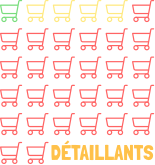
Supermarket private-label products sit right next to big company brands on the shelves. They compete on price, packaging, and procurement.
The reality is:  1 out of 32 retailers scored green.
 4 out of 32 retailers scored yellow.
 27 out of 32 retailers scored orange or worse.
Some retailers are getting ahead by hitching their own-brand chocolate to programs that are already doing the hard work on the ground.
Consumers expect better. Will you step up?
Toxic &
Unacceptable

Pesticide use remains dangerously high.
Children breathe what is sprayed on a cocoa farm and most of the industry still cannot tell you what is being sprayed.
Companies have programs that monitor pesticides at policy level without knowing where these poisons are being used. This is poisoning the health of farming communities — especially children and pregnant women — and damaging the environment.
The harm is real. The solutions exist.
We still do not know
what
34%
of farmers earn

Less than one in three farmers in major chocolate supply chains are known to be earning a living income.
Deforestation
Regulations
WORK
Now We Need
Global Action
65%

Cocoa traceable and deforestation-free
Regulations have lifted verified deforestation-free cocoa to 65% of the supply. Regulations can drive results.
But we're not there yet. As the watched supply chain in West Africa tightens up, the pressure is moving — to Liberia and the Congo Basin, where almost nobody is yet watching.
The audit cycle starts 30 December 2026. Eight companies could already pass. The rest need to catch up.
The regulations need to follow the cocoa.
Child Labor
Time to tackle root causes

The data is clear—everyone knows child labor is rampant in cocoa.
But here’s the truth: 25 years after the first promises to eliminate child labor, it’s still happening.
We have learned how to find children in cocoa fields. We have not learned how to make sure their families don't need to send them.
Time to innovate, tackle root causes, and drive real, systemic change.
The time for half-measures is over.
With Great Wealth Comes Great Responsibility
The six biggest chocolate brands make over USD226 billion combined. Meanwhile the combined GDP of Ghana and Cote d’Ivoire, the two leading cocoa producers, is approximately USD155 billion.
These companies have the power—and the profits—to drive real change. Yet, too many farmers remain trapped in poverty while chocolate giants profit.
GDP of Ghana and Cote d’Ivoire
$155
billion usd
6 biggest chocolate brands make
$226
billion usd
It’s time for the industry’s biggest players to step up. Will they?


Traceability and Transparency
If You Can't See It, You Can't Fix It

The EUDR is driving the movement — traceability is much higher among companies that need to comply — and the industry is shifting from mass balance to segregated or identity-preserved sourcing.
Companies that need to comply with the EUDR for more than 50% of their volume can trace:
84% to farmer group and 67% to farmer
Companies that need to comply with the EUDR for less than 50% of their volume can trace:
45% to farmer group and 39% to farmer
Traceability is the ability to track a cocoa bean back through the supply chain to its source. Transparency is whether a company will share what it knows.
Both are improving in the 7th Edition, at different speeds. Traceability has moved further and faster than ever before, pulled by regulation. Transparency, the part the public can actually see, has barely moved at all.
When companies refuse to participate in initiatives like the Chocolate Scorecard, it's a red flag.
About nine in every ten cocoa beans grown in the world pass through a company the Scorecard has assessed, so declining is a hole punched in a near-complete picture.
Traceability itself is increasing. Traceability to farmer group rose by 8% from 2025 to 2026; traceability to farmer rose by 5%.
But what companies can see internally is not what they share publicly. Most still publish only farmer-group names, without geographic coordinates. When companies use "transparency" to mean their own internal visibility rather than what they share publicly, the ambiguity works in their favor. It evokes openness without delivering it.

Living income
The Lights Came On
For years, we estimated. Now we measure. The Scorecard has long asked companies to provide evidence of their living-income commitments — what is paid, who receives it, and on what share of supply. This year, we have answers. The picture is sharper than ever, and starker than anyone assumed.
We asked. They looked. We have answers. Now we all know.
The unknown is shrinking — and most of what was revealed is not good news.
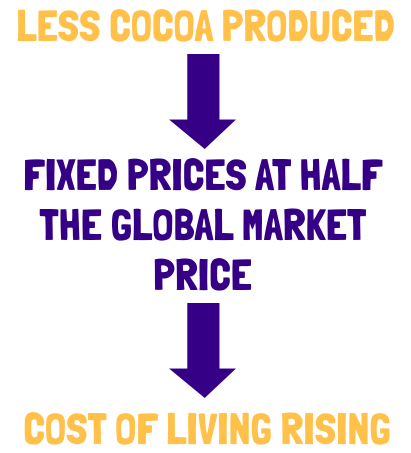
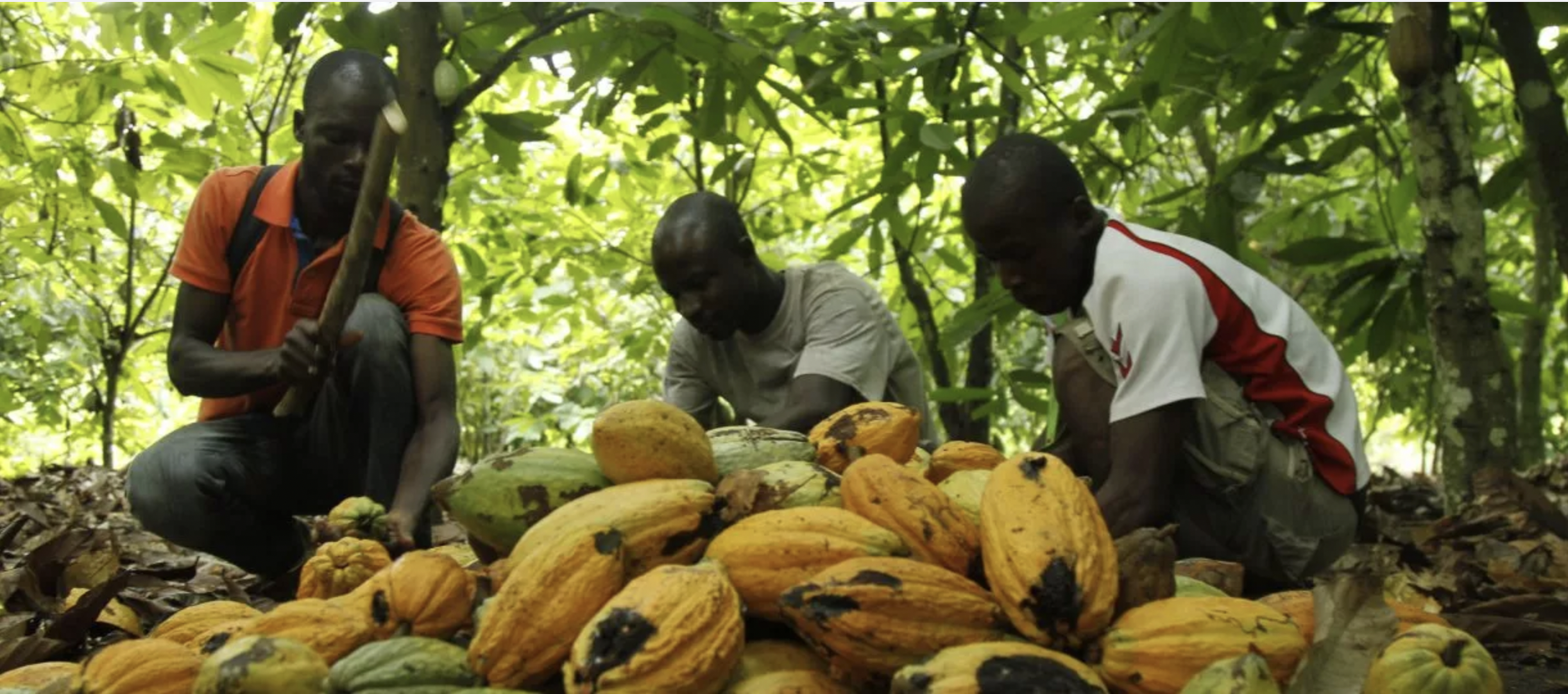
Farmers are producing less and selling at a fraction of global market price. In Côte d'Ivoire and Ghana, government regulators set the farmgate price; in 2024, that price was less than half the global market. In 2026, the global market dropped below the farmgate price, and companies looked elsewhere to buy. Either way, the farmer rarely benefits from the high prices the rest of the supply chain sees.
Even where farmers receive higher prices, the gain is thin. Production costs are up. Compliance is more demanding. The cost of living has risen faster than cocoa earnings. Higher prices at the till are not reaching the people who grow the bean.
WHY THE SCORES SHIFTED
Some companies investing seriously in farmer income saw their scores fall. They did not do less.
Living Income is now the lowest-scoring section of the Scorecard. The 49-company average is 30.4%.
For some companies, the score drop reflects sharper measurement of programs that already existed. Income accelerators, origin-by-origin pricing, and certification-anchored programs that once reported intention now report household-level evidence. As measurement matures, the gap that was always there has become visible.
Most do not yet have a calculated benchmark, a mechanism that puts enough money in farmers' pockets, or a purchasing-practice approach. Certification premiums, supplier codes of conduct, and small pilots are not substitutes for the three things the Chocolate Scorecard rewards. |
Where Living Income Lives or Dies
DOES THE COMPANY KNOW HOW MANY FARMERS ARE EARNING A LIVING INCOME IN ITS SUPPLY CHAIN?
Earning Living Income
Not earning Living Income
Unknown
Many companies sent us procurement policies. A procurement policy is not a purchasing practice. A code of conduct is not a purchasing practice. A supplier sustainability requirement is not a purchasing practice. A purchasing practice is how a company actually buys: contract terms, price formula, volume commitment, duration of relationship, and who carries the price risk when markets move. That is where living income lives or dies.
The Scorecard rewards three things working together:
a calculated benchmark for what a farming household needs to earn,
a mechanism for payment that puts enough money in farmers' pockets, and
a purchasing-practice approach that makes both durable.
Most companies have one. Few have all three.

Child Labor
A Promise Broken
In 2001, the chocolate industry made a bold promise: to eliminate child labor from cocoa farming. They set deadlines, missed them, and set new ones. By 2020, they vowed, no child would work in hazardous conditions on cocoa farms. Yet, in 2026, that promise remains unfulfilled.
Do 1.5 million
children
still work on
cocoa farms?

The last major research project, in Côte d’Ivoire and Ghana, is now eight years old. In that time we have learned how to find children in cocoa fields. We have not learned how to make sure their families don't need to send them.
Companies can name the children working in their supply chain. It still won't pay the price for cocoa that would send them home or to school.
All 49 participating companies and retailers have policies to monitor, remediate, reduce, and eliminate child labor. 94% of big companies and 70% of retailers have systems in place to actually address it. The leaders pair detection with prevention — case-by-case remediation alongside structural work on the conditions that put children in the fields in the first place: living-income payment, school access, birth-certificate registration, women's savings groups, alternative adult labor at peak harvest. The much larger group has detection alone.
Few of those systems yet report separately on girls and boys. Girls' work is mostly invisible in farm-based monitoring because it happens inside the home — and what isn't counted isn't addressed. Gender-disaggregated child-labor monitoring is the next standard the Chocolate Scorecard will reward.
MEDIUM AND LARGE COMPANIES REPORTING ON CHILD LABOR CASES
- Yes
- No
Transparency is improving. In 2023, only 45% of companies shared child labor data. By 2025, that number rose to 82%. This year, 94% of big companies reported data on child labor.
The kind of granularity we are seeing in reporting was unimaginable a decade ago. The chocolate industry has built one of the most extensive supply-chain monitoring systems in any consumer-goods sector. It has not yet built the corresponding paying system.

Deforestation
A Crisis Unfolding
West Africa currently produces over 70% of the world’s cocoa. But this comes at a devastating cost. In the last 60 years, Côte d’Ivoire has lost 94% of its forests, and Ghana has lost 80%. A third of this destruction was to make way for cocoa farms.
The Congo Basin (covering Cameroon, Gabon and the Republic of the Congo) is Africa's largest rainforest and home to gorillas, chimpanzees, and countless other species. It is now under threat. Cocoa farming is driving deforestation in the Congo Basin at seven times the rate of other crops.
Protecting the world's last remaining rainforests is of utmost importance.


94%-80%
loss of forest in the last 60 years
More than
75%
of the world’s cocoa, mostly in Côte d’Ivoire and Ghana
Addressing deforestation
The industry is finally being asked to prove what it has been claiming. The European Union's Deforestation Regulation (EUDR) bans the sale in Europe of cocoa grown on land cleared after 2020 and starts its first audit cycle on 30 December 2026. New due-diligence rules under the EU's Corporate Sustainability Due Diligence Directive (CSDDD) extend the principle beyond Europe's borders.
The bar has moved from policy to evidence — from "we have a commitment" to "we have a verified percentage."
The Industry's Response: Promises and Gaps
96%
of participating companies have a deforestation policy.
90%
commit to deforestation-free supply chains.
76%
target 2025 or earlier.
IS THE COCOA DEFORESTATION FREE?
Known to be deforestation free
Deforested or unknown
The results
From 30 December 2026, the European Union's Deforestation Regulation begins its first audit cycle. The first question auditors will ask is the simplest one: What percentage of your cocoa is verified deforestation-free?
Across the 2026 Chocolate Scorecard, 65% of the cocoa bought by participating companies is confirmed deforestation-free. The remaining 35% — over 2 million tonnes — comes from deforested or unknown sources. 62% of cocoa is traceable to the farmer group; 55% sits inside a deforestation monitoring system. All three figures are about ten percentage points higher than last year.
The companies that do this well treat the data as something farmers and cooperatives should own and use, not just a compliance asset that flows back to head office. That distinction is what separates verification done with farmers from verification done to them.


Agroforestry and Climate
A Path to Healing the Planet
Cocoa has been a major driver of deforestation, but it can also become a way to re-green the planet.
Mainstreaming cocoa agroforestry in West and Central Africa is a monumental task. The good news is we know what works. The next step is to scale it — together, and at the speed the climate and these landscapes need. Agroforestry is the judicious management of remnant trees from the original forest, natural tree regeneration, and trees planted in cocoa plots. Current agroforestry initiatives reach only a small share of farmers and a small share of the cocoa landscape — and that's the gap we can close.
Dr. Eduardo Somarriba and Dr. Arelene López Sampson, Agroforestry experts
Agroforestry is a win-win. It can:
A
Capture more carbon, helping fight climate change.
B
Improve soil health and retain moisture, making farms more resilient.
C
Support biodiversity, creating habitats for birds, insects, and other wildlife.
D
Diversify farmers’ incomes, so they’re not solely dependent on cocoa.
Monoculture cocoa farming – growing cocoa alone – leaves farms vulnerable to droughts, floods, and pests. It’s bad for biodiversity and bad for farmers.
Full-sun monoculture
Diverse agroforestry systems in place
Old-growth forest with (risk of) new cocoa farms encroaching

The Reality: Agroforestry’s Untapped Potential
No specific policies
Few Companies
have a specific cocoa-agroforestry policy. Most fold it into a broader sustainability strategy or rely on what their certifications already cover.
More than counting
The RIGHT INGREDIENTS for the RIGHT RECIPE.
Species mix, shade and structure for the soil, climate and community the farm sits in — measured, not just promised.
Support Provided
60% OF COMPANIES SUPPORT FARMERS
with seedlings or Payments for Ecosystem Services.
They just don’t say how many farmers, or how much of their supply chain it reaches.
Agroforestry isn’t just planting trees — it’s a five-part promise: volumes bought, plot design, farmer income, carbon stored, and customers brought along.
For many companies, agroforestry is a sentence inside a sustainability report. For the leaders, it’s a standalone policy with volumes, dates and accountability attached — and trees in the ground that match the policy. The chocolate industry has, on average, made progress on the paperwork. It has not yet, as a rule, planted the trees.
Agroforestry done well isn’t a tree count. It’s the right mix of species, shade and structure for the soil, climate and community the farm sits in. Less than two-thirds of participating companies have policies tailored to specific countries. The Scorecard will look at country-specific design in the future.
A small specialist who buys all of its cocoa from one cooperative can put agroforestry on every farm and report 100% coverage. A global trader who sources from millions of farmers cannot match that percentage even when its absolute reach is larger. Neither metric tells the whole story. The Scorecard will start showing both side by side.
Climate sits in the same section because the cocoa supply chain is where the chocolate industry’s carbon mostly lives. Most companies still don’t include their cocoa sourcing in their scope-3 emissions accounting — the gap between the climate target on the cover of the annual report and the climate evidence on the cocoa farm is the one regulators will close next. Eleven mid-tier chocolate makers slipped on environment scores between editions; the scoring tightened on tree counts at the farm and active-ingredient data per supplier, and the slip is mostly the rubric meeting the road.

Pesticides
A Silent Crisis
Every year, 44% of cocoa farmers suffer acute pesticide poisoning. Children are exposed to these toxic chemicals, risking chemical burns, migraines, vomiting, paralysis, and even death. Pesticides also devastate the environment, killing pollinators like midge flies that cocoa trees rely on. These pollinators are highly sensitive to the chemicals regularly used in cocoa production.
Pesticide policy
95%
of the large companies
90%
of the retailers
have a pesticide policy.
A policy is the floor.
The next questions — what's allowed, what's restricted, who tracks it — are where the leaders and the laggers part ways.
Certifications
29%
of the large companies
50%
of the retailers
rely solely on certifications like Rainforest Alliance or Fairtrade. Used at full scale, certified supply is the leverage point — the small specialists who score green source 100% certified, and active-ingredient data is collected at the farm by the certifier. Used as a minor sourcing line, certification is a label, not a system.
Companies are beginning to understand the issue. Each year, more companies have identified specific chemicals to phase out. But the next step — actively collecting data, supporting farmers to transition to safer practices, and providing a safe way to dispose of pesticide containers — is lagging.
Children breathe what is sprayed on a cocoa farm. Most of the industry still cannot tell you what is being sprayed. The chocolate industry has spent fifteen years building child-labor monitoring; it has not yet built equivalent monitoring for what reaches children’s lungs and skin. The 7th Edition Chocolate Scorecard tightened on data tracking and on active-ingredient disclosure. Companies that monitor pesticides at policy level — without disaggregating which active ingredients are being used, by which supplier — fell, and the scoring is the reason.
We determined that only 20% of companies were actively collecting data on pesticides in their supply chains.
What the leaders are doing differently
Six companies score green on Pesticides this edition. Four are small specialists who source 100% certified — the certifier collects active-ingredient data at the farm and the company publishes it. Two are larger manufacturers who pair high-percentage certified-and-direct sourcing with farmer-level programs that link pesticide reduction to tree-cover policy. The structural pattern across the green band is the same: pesticide reduction is engineered into the cocoa-purchasing model, not added on top of it. The strong yellows have the policies. The greens have the operational depth — programs that support farmers to reduce the need for pesticides through good pest management, not just safer ways to apply them.


Gender Equality
The Overlooked Key to Sustainability
Women are equally involved in cocoa farming, but cocoa is still treated as a man's job. Female farmers are held back by gender-based cultural, institutional and social norms — less access to land, less access to credit, less access to training, less access to the resources that make a farm work. These are not gaps a single programme can close. They are the structural shape of the supply chain. A sustainable cocoa industry has to confront that shape directly, not treat gender as a workshop bolted on the side.
Research shows that gender equality:
• Reduces child labor. When women hold income and decision-making power in the household, children are more likely to be in school and less likely to be working.
• Improves family welfare. Women's earnings flow disproportionately into children's nutrition, health and education — the structural enablers that lift the whole household.
• Strengthens supply-chain resilience. Women-led farms more often adopt agroforestry, diversified income and sustainable input practices — the things that keep cocoa land productive for the next generation.


Encouraging numbers
59%
of manufacturers and traders have a substantive gender strategy
59%
of companies integrate gender into their child labor approach
59%
integrate gender into their living income approach
Most companies now have a gender policy on paper. The next bar is harder: translating those policies into practices that change what happens in real farming households — fairer pay reaching women, women owning and inheriting land, women leading inside the farmer groups that companies buy from.
Girls experience child labor differently from boys, and a child-labor monitoring system designed for the farm will miss them. Boys are more likely to be found doing visible, hazardous work in the field — carrying heavy loads, applying chemicals. Girls' work is more often inside the home: cooking, fetching water, caring for younger siblings, processing beans. It looks like helping out, so it goes uncounted. When companies report that their child-labor monitoring is working, the question that matters is: working for whom? If the data isn't disaggregated by gender, if monitoring doesn't extend to domestic labor, the system has a blind spot the size of half the population.
Supply chain
31%
of manufacturers and traders track how many women hold leadership positions at the farmer groups they buy from.
Almost none measure whether those women hold actual authority, voice or decision-making power inside the group.

Farmer Health
A chocolate bar is not just cocoa, sugar and milk. It is also the hands that pruned the tree and the family that lived alongside the crop. How those people are treated is part of what you are buying.
Farmers are not an input. They are part of the product.
The 7th Edition Chocolate Scorecard, for the first time, includes Farmer Health as its own section. Companies were invited to answer the questions and be scored. Their responses are not public this year — a starting line, not a verdict — but the questions are now on the table. The inaugural Farmer Health Award goes to The Hershey Company, for treating farmer health as a corporate responsibility, not a side project. A living income alone will not solve this. Money in a pocket cannot conjure a clinic or catch a family when crisis hits. Real progress needs four things together:
A safety net for crises — so one illness or bad season doesn't push a family into destitution.
Prevention first — clean water, nutrition, protective equipment, mental health.
Good healthcare, actually available — within reach, affordable, trusted.
Local voices leading the design — solutions imposed from a head office rarely fit.
Farmer health is not a charitable add-on. It is part of what makes the chocolate worth eating.